Recently, I was traveling through the upper Midwest (Nebraska, South Dakota) and had the opportunity to meet up with a long-time friend and not-often-enough collaborator, Éireann Lorsung. While we were catching up, the sticky subject of AI-generated imagery came up. I mentioned the main operator of text-prompt to image generation services (OpenAI’s ChatGPT) still offers the eerie and just plain weird ability to take an image of oneself and generate some facsimile of what the AI thinks would be an “ideal partner”.
You may now cringe.
Knowing of my inability to resist such things (even when I know I clearly should), I uploaded a photo of myself and asked the mystical oracle who it is I should be spending my life with. (Apologies to Samuel, my husband of the last 6 years). I ended up being creepily matched with a very handsome, younger Latino apparition with a killer set of abs and a distinct lack of a thumb. The AI called him Alex and then abruptly changed his name to Matteo for some reason beyond me.
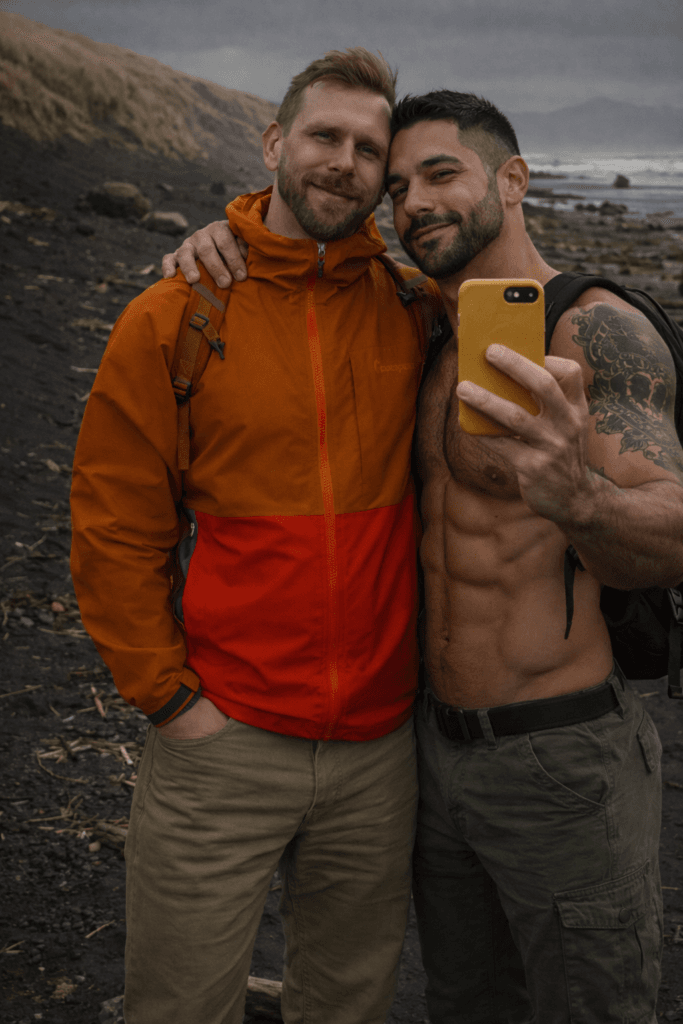
Embedded in this act of narcissistic waste of water and electricity is something much darker and persistent, something that Éireann identified in the 1975 writing, “Fascinating Facism” by Susan Sontag. To very loosely summarize, Sontag suggests that fascism persists less as doctrine than as an aesthetic grammar—one that eroticizes power, idealizes bodies, and organizes desire through spectacle. She gives the example of the films and final photography book work of the Nazi, Leni Riefenstahl.
Alex turned Matteo certainly has the idealized form repeated and emulated by (hopefully) real gay human beings on platforms such as Grindr. (Though, Grindr, after its adventures in private capital enshitiffication has announced they are leaning into AI. More on this in another post, I’m sure).
What is the point of all this blathering and grasping to connect two seemingly dissimilar modes of image creation and circulation?
Simply:
As fascism creates and relies on a libidinal arrangement of looking, so too does AI image slop depend on these libidinal hooks to capture our attention.
After all, had Alex/Matteo embodied a much more realistic body type, would any of this had held my attention?
And that is where this series of posts about AI imagery, photography, and those darn libidinal hooks begins. Hoping to follow up with:
- Part II—The Libidinal Economy of the Image
- Part III—AI Image Systems as Aesthetic Optimization Machines
- Part IV—The Perfected Body: From Riefenstahl to Render
- Part V—Engagement as Libidinal Governance
- Part VI—Grindr, Desire, and the Algorithmic Ideal
(or something like that)